
The impact of climate change on the fall armyworm
The impact of climate change on the fall armyworm (Spodoptera frugiperda)
Introduction to the pest
The fall armyworm (FAW), Spodoptera frugiperda, is an invasive, transboundary, highly destructive plant pest tropical and subtropical origin. It affects over 70 countries/regions and is known for its very long flight distances (over 100 km per night), high reproductive rates and adaptability, which contribute to its success in causing significant losses to agricultural production (11 Johnson, 1987; Secretariat of the International Plant Protection Convention (7 IPPC Secretariat, 2021). Temperature plays an important role in the population dynamics of the FAW, particularly its metabolic states and developmental rates, and thus indirectly the degree of crop infestation (16 Yan et al., 2022). Its life cycle consists of six larval instars, followed by pupal and adult stages. The duration of each stage of the FAW is heavily influenced by temperature, which is a critical factor in determining the pest's development rate, survival, and overall population growth (16 Yan et al., 2022). One complete generation can be completed in 28 to 90 days under optimal and colder temperatures respectively (7 IPPC Secretariat, 2021; 4 Chen et al., 2022). The FAW is a polyphagous pest that can feed on over 80 plant species, many of which are economically important crops such as maize, rice and sorghum (7 IPPC Secretariat, 2021).
Origin and distribution
The FAW is native to the tropical and subtropical regions of the Americas. Its original range extends from the United States of America to Argentina, with seasonal migrations occurring in North America. The potential global distribution of S. frugiperda has been estimated using various modelling approaches. The results suggest that the pest has the potential to establish in many regions worldwide, particularly in areas with warm climates (5 Early et al., 2018; 6 Fan et al., 2020; 15 Wang et al., 2020; 17 Zacarias, 2020; 3 CAI et al., 2021; 2 Barkessa et al., 2024). The FAW has rapidly expanded its global range. It was detected on the African continent in 2016 and quickly spread through Central and Western Africa. The pest has also invaded parts of Asia, including India and Yemen in 2018, as well as Pakistan and Nepal in 2019 (Rwomushana, 2020). In 2020, FAW also spread to Australia and the United Arab Emirates. While it has also been detected in the Canary Islands (Spain), Türkiye, Crete, Cyprus and Romania, and continues to spread to new regions (10 Goergen et al., 2016; 12 Rwomushana et al., 2018; 9 FAO, n.d.-a).
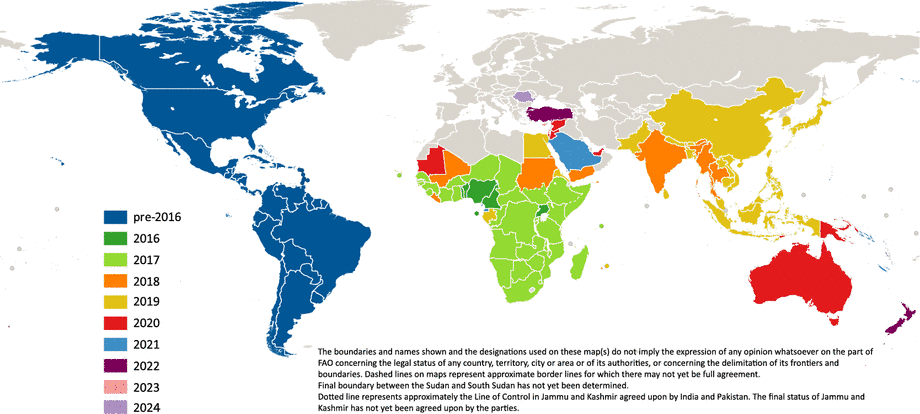
Figure 1: Distribution of the fall armyworm since 2016. Source: 9 FAO. n.d.-a. Global Action for Fall Armyworm Control. In: Food and Agriculture Organization of the United Nations. [Cited 1 March 2025]. https://www.fao.org/fall-armyworm/monitoring-tools/faw-map/en/
How the distribution and impact of the pest are affected by weather and climate
Temperature is the dominant abiotic factor affecting the distribution and impact of FAW. As an ectothermic species without a diapause mechanism, S. frugiperda cannot survive extended periods of extreme cold temperatures (16 Yan et al., 2022). Increasing temperatures, however, can have favourable effects on the development of S. frugiperda populations. In combination with other favourable factors such as wind drift, this can lead to a long-distance distribution and a high pest risk for crops (14 Urhausen et al., 2025).
The effect of temperature on FAW can be both direct and indirect:
Direct effects: Temperature influences the pest's distribution and flight performance, physiology and abundance (1 Bale et al., 2002). For example, rising temperatures within a certain range (typically between 17 °C and 35 °C) can cause a shortening of the developmental period of S. frugiperda, potentially leading to more generations per year and increased crop damage.
Indirect effects: Temperature impacts host plants and natural enemies, which in turn affect the population dynamics of FAW (16 Yan et al., 2022).
Simulation models have identified key bioclimatic variables that influence the habitat suitability of S. frugiperda. Annual mean temperature, temperature seasonality and precipitation are the main variables, which play a crucial role in determining the pest's distribution and potential impact on crops (5 Early et al., 2018; 16 Wang et al., 2020; 3 Cai et al., 2021).
How climate change may alter the distribution and impact of FAW in the future
Climate change is likely to significantly alter the potential distribution, abundance and impact of S. frugiperda in the future. Modelling studies have predicted an overall increase in the area suitable for FAW as global temperatures rise. In the People’s Republic of China, for example, the unsuitable area for FAW will likely decrease by 4 percent to 9 percent depending on the climate change scenario (RCP2.6, RCP4.5, RCP6.0 and RCP8.5), while marginally suitable areas are likely to increase by around 6 percent to 17 percent (3Cai *et al*., 2021). Highly suitable habitats may decrease in some scenarios (RCP2.6 and RCP4.5) but increase significantly in others (RCP6.0 and RCP8.5), with increases of up to 22 percent (3 Cai et al., 2021; 2Barkessa et al., 2024).
The expansion of suitable habitats could also lead to:
-
increased geographical range of the pest;
-
higher population densities in currently affected areas;
-
transition from a transient occurrence to a year-round occurrence; and
-
greater crop damage and economic losses in old and newly suitable regions.
What can national plant protection organizations (NPPOs) do to prevent and mitigate future impacts
NPPOs can take several proactive measures to mitigate the (future) impacts of FAW in the face of climate change:
Enhanced surveillance: Implement comprehensive surveillance and monitoring programmes to detect early infestations and track the spread of FAW. This is particularly important in areas predicted to become suitable for the pest under future climate scenarios.
-
Risk assessment and mapping: Utilize climate modelling and species distribution models to identify high risk areas of FAW invasion or population increase. This can help prioritize resources such as setting up surveillance schemes, and target interventions effectively.
-
Research and development: Invest in research on climate-resilient crop varieties that can withstand FAW infestations and on improved surveillance techniques to detect an introduction/outbreak as soon as possible. It will also be helpful to study the impact of climate change on the natural enemies of FAW and explore new biological control options.
-
Integrated pest management strategies: Develop and promote environmentally friendly and economical control measures such as integrated pest management programmes that are appropriate in the respective environment and under the given conditions; and that are also adaptable to changing climatic conditions. This may include a combination of cultural practices, biological control and judicious use of pesticides.
-
International cooperation: Collaborate with other NPPOs and international organizations to share data, research findings, and best practices for managing FAW under changing climatic conditions. Participate in regional early warning systems to detect and respond to FAW outbreaks promptly (e.g. 8 FAO, n.d.-b).
-
Capacity building: Train agricultural extension workers and farmers on FAW identification, surveillance, and management techniques that are effective under various climate scenarios. Educate stakeholders about the potential impacts of climate change on FAW distribution and severity.
-
Policy development: Implement and enforce phytosanitary measures to prevent the introduction and spread of FAW, taking into account potential new pathways that may emerge due to climate change. Develop contingency plans for rapid response to FAW outbreaks in newly suitable areas.
-
Adaptive management: Regularly review and update management strategies based on new research findings and observed changes in FAW behaviour and distribution due to climate change.
References
1 Bale, J.S., Masters, G.J., Hodkinson, I.D., Awmack, C., Bezemer, T.M., Brown, V.K., Butterfield, J., Buse, A., Coulson,
J.C., Farrar, J., Good, J.E.G., Harrington, R., Hartley, S., Jones, T.H., Lindroth, R.L., Press, M.C., Symrnioudis, I.,
Watt, A.D. and Whittaker, J.B. 2002. Herbivory in global climate change research: direct effects of rising temperature
on insect herbivores. Global Change Biology, 8: 1–16.
2Barkessa, M.K., Degaga, E.G., Duressa, T.F., Muleta, M.G., Amenta, M.W. and Gurmu, A.K. 2024. Factors influencing the
current and future distribution of the fall armyworm, Spodoptera frugiperda (Lepidoptera: Noctuidae), in Ethiopia.
Agricultural and Forest Entomology, 27(3):377–387.
3Cai, P.M., Meng, F.H., Song, Y.Z., Ma, C.H., Peng, Y.W., Wu, Q.F., Lei, S.Y., Hong, Y.C., Huo, D. and Li, L. 2021.
Maxent modeling the current and future distribution of the invasive pest, the Fall Armyworm (Spodoptera Frugiperda)
(Lepidoptera: Noctuidae), under changing climatic conditions in China. Applied Ecology and Environmental Research, 19:
4527–4546.
4Chen, Y.-C., Chen, D.-F., Yang, M.-F. and Liu, J.-F. 2022. The effect of temperatures and hosts on the life cycle of
Spodoptera frugiperda (Lepidoptera: Noctuidae). Insects, 13(2): 211.
5Early, R., González-Moreno, P., Murphy, S.T. and Day, R. 2018. Forecasting the global extent of invasion of the cereal
pest Spodoptera frugiperda, the fall armyworm. NeoBiota, 40, 25–50.
6Fan, J., Wu, P., Tian, T., Ren, Q., Haseeb, M. and Zhang, R. 2020. Potential distribution and niche differentiation of
Spodoptera frugiperda in Africa. Insects, 11(6), 383.
7IPPC Secretariat. 2021. Prevention, preparedness and response guidelines for Spodoptera frugiperda. Rome, Italy. FAO on
behalf of the Secretariat of the International Plant Protection Convention. 36 pp.
8FAO. n.d.-b. Global action for fall armyworm control – FAMEWS mobile app.
https://www.fao.org/fall-armyworm/monitoring-tools/famews-mobile-app/en/
9FAO. n.d.-a. Global action for fall armyworm control. In: Food and Agriculture Organization of the United Nations.
[Cited 1 March 2025]. http://www.fao.org/fall-armyworm/monitoring-tools/faw-map/en/
10Goergen, G., Kumar, P.L., Sankung, S.B., Togola, A. and Tamò, M. 2016. First report of outbreaks of the fall armyworm
Spodoptera frugiperda (J.E. Smith) (Lepidoptera, Noctuidae), a new alien invasive pest in West and Central Africa. PloS
one, 11, e0165632.
11Johnson, S.J. 1987. Migration and the life history strategy of the fall armyworm, Spodoptera Frugiperda in the western
hemisphere. International Journal of Tropical Insect Science, 8, 543–549.
12Rwomushana, I. 2020. Spodoptera frugiperda (fall armyworm). CABI Compendium, 29810.
https://doi.org/10.1079/ISC.29810.20203373913
13Rwomushana, I., Bateman, M., Beale, T., Beseh, P., Cameron, K., Chiluba, M., Clottey, V., Davis, T., Day, R., Early, R.,
Godwin, J., Gonzalez-Moreno, P., Kansiime, M., Kenis, M., Makale, F., Mugambi, I., Murphy, S., Nunda. W., Phiri, N.,
Pratt, C. and Tambo, J. 2018. Fall armyworm: Impacts and implications for Africa. CABI Evidence Note, October 2018.
14Urhausen, S., Bradshaw, C.D., Davie, J., Eyre, D., Hemming, D., Li, H., Taylor, B. and Zhang, F. 2025. Climate-related
risk to maize crops in China from fall armyworm, Spodoptera frugiperda. Journal of Pest Science, 98 (2), 959–972.
https://doi.org/10.1007/s10340-024-01817-7
15Wang, R., Jiang, C., Guo, X., Chen, D., You, C., Zhang, Y., Wang, M. and Li, Q. 2020. Potential distribution of
Spodoptera frugiperda (J.E. Smith) in China and the major factors influencing distribution. Global Ecology and
Conservation, 21, e00865.
16Yan, X.-R., Wang, Z.-Y., Feng, S.-Q., Zhao, Z.-H. and Li, Z.-H. 2022. Impact of temperature change on the fall armyworm,
Spodoptera frugiperda under global climate change. Insects, 13 (11), 981.
17Zacarias, D.A. 2020. Global bioclimatic suitability for the fall armyworm, Spodoptera frugiperda (Lepidoptera:
Noctuidae), and potential co-occurrence with major host crops under climate change scenarios. Climatic Change, 161,
555–566.