
The impact of climate change on Xylella fastidiosa
The impact of climate change on Xylella fastidiosa
Introduction to the pest
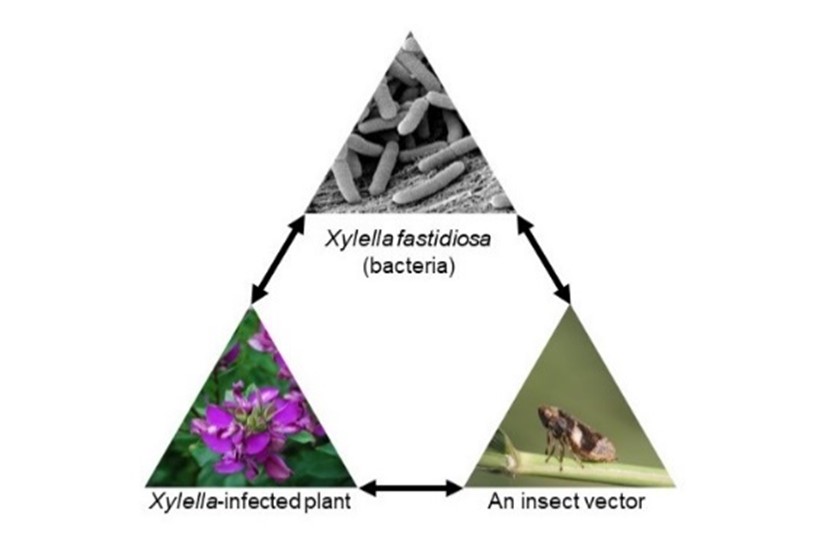
Xylella fastidiosa is a plant pathogenic bacterium that lives in the xylem vessels of its hosts. As it multiplies it blocks these vessels, disrupting water transport throughout the plant. It is spread between plants by insect vectors that feed on the xylem (Figure 1.)
Figure 1. The cycle of Xylella fastidiosa between host plants and vectors https://www.jic.ac.uk/brigit/what-is-xylella-fastidiosa/, Xylella image courtesy of Electron Microscope Laboratory, University of California, Berkley |
 |
X. fastidiosa has a vast range of identified hosts, including many important crops. It is divided into three major sub-species. The sub-species have overlapping host ranges, but different geographic origins and are associated with diseases in different hosts. The three main sub-species are Xylella fastidiosa subsp. fastidiosa (cause of Pierce’s disease of grapevine), X. fastidiosa subsp. multiplex (is associated with diseases in trees including Prunus spp.) and X. fastidiosa subsp. pauca (cause of diseases in citrus and olives) but only the first two of this list have validly published names (9 Greco et al. 2021).
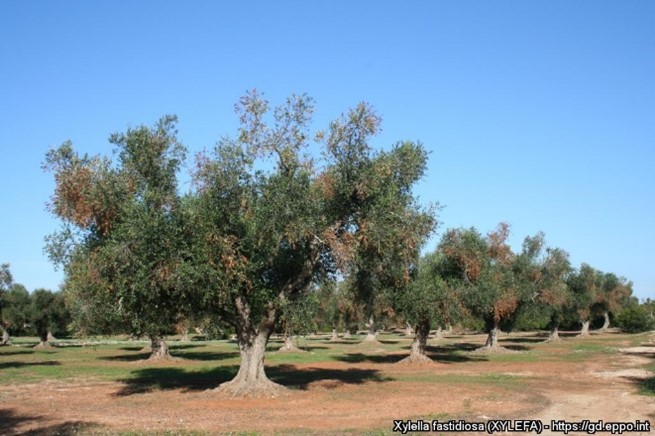
Symptoms of olive quick decline, Puglia, Italy. Courtesy: Donato Boscia, CNR - Institute for Sustainable Plant Protection, Bari, EPPO global database |
 |
X. fastidiosa is considered to be a worldwide threat to agriculture, horticulture, forestry, and unmanaged habitats. As of February 2025, 713 plant species in 89 familes had been reported as hosts (3 EFSA et al. 2025). The hosts include important crops such as those listed below, deciduous trees and many other plants that are present in uncultivated areas. In some hosts and some environments, Xylella can remain asymptomatic for many years.
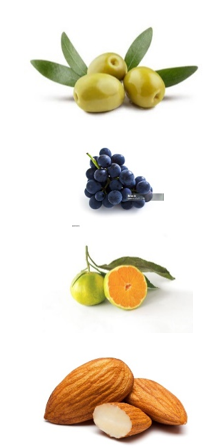 | Xylella has been estimated to have reduced the profitability of olive production in the Salento in southern Italy by EUR 132 million per year (2 Calderoni et al. 2025) |
Origin and distribution
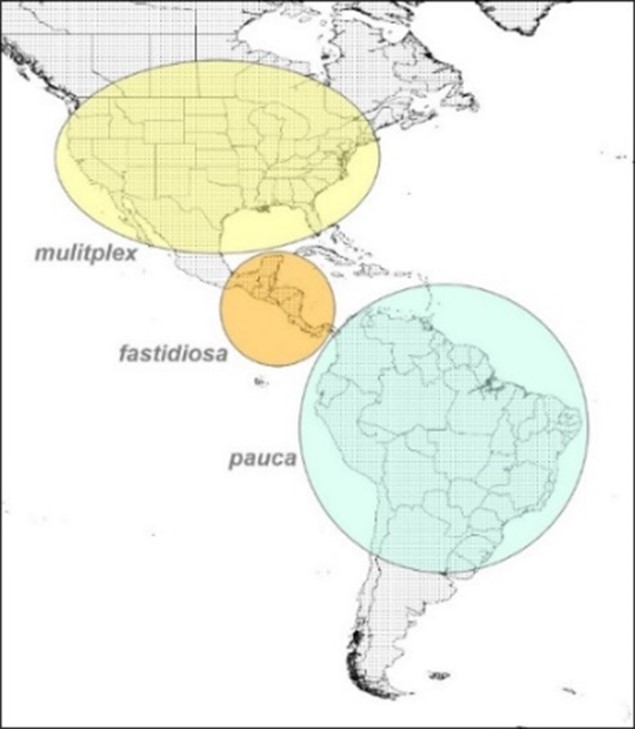
The origins of the sub-species are shown in Figure 2 and the invasive distribution in Europe and the Near East is shown in Figure 3.
 |
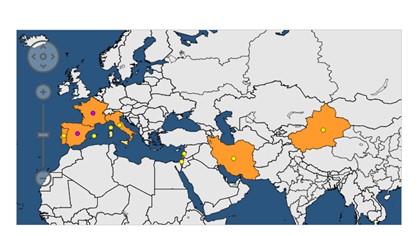 | |
Figure 2: Xylella fastidiosa originates from the Americas and the three main sub-species have different origins within America (1 Almeida and Nunney 2015). |
Figure 3: Xylella is now present in four European countries (Portugal, Spain, France and Italy), plus in the Near East and Asia (Israel, Iran and China). Purple dots indicate transient populations whereas yellow indicates where there are areas of containment. (Source: EPPO Global database) |
How the distribution and impact of the pest are affected by weather and climate
The different sub-species of X. fastidiosa have different geographical distributions and there is evidence that they respond differently to high and low temperatures. In a laboratory study in which grapevine (Vitis vinifera) seedlings were innoculated with X. f. subsp. fastidiosa over 18 days, the bacteria persisted at 25°C, 17°C and 10°C, but declined at 37°C, 5°C and 34°C with the decline happening most quickly at 37°C. The optimum temperature for growth of X. f. subsp. fastidiosa is around 28°C (5 Feil and Purcell 2001).
Cold temperatures can eliminate X. fastidiosa from some hosts in a process known as ‘cold-curing’ (11 Leith et al. 2011). Cold winter temperatures have also been shown to be a limiting factor on Xylella for example by limiting the distribution of phony peach disease, caused by X. fastidiosa subsp. multiplex to the southern states of the United States of America (13 Purcell 2023). In Europe, despite the likelihood of numerous introductions over the years, X. fastidiosa has not established populations further north than the Occitanie region of France (8 Godefroid et al. 2022). The link between Xylella incidence and temperature has been demonstrated in a study of vectors on the Mediterranean island of Corsica. The frequency of vectors positive for Xylella has been found to correlate with temperature and higher prevalence has been shown to correlate with milder winters (4 Farigoule et al. 2022).
The severity of Pierce’s disease can be influenced by the availability of water with more severe impacts seen in plants under water deficit (16 Thorne et al. 2006). In addition to the direct impact of temperature on Xylella, climate can also have an impact on the pathogen by influencing the population dynamics, rate of dispersal and behaviour of its vectors.
How climate change may alter the distribution and impact of Xylella in the future
There is some anecdotal evidence that climate change has already had an influence on the impacts of Xylella. In June 2017, symptoms of leaf scorch were seen on 30 year-old trees in serveral almond orchards in Alicante, in eastern Spain. Symptom development followed a period when average temperatures were 3.2°C higher than in at least the previous seven years. These observations suggest that Xylella had been present in the trees for many years, but it was the period of unusually warm weather that led to the symptoms and impacts on the almond trees (12 Marco-Noales et al. 2021).
Climate change could alter the geographical range and population density and behaviour of Xylella vectors, aiding the establishment of the pathogen in new areas (14 Rossi and Rasplus 2023). Warmer winters could aid the spread of X. fastidiosa into new areas because of the reduced impact of cold curing (15 Saifi et al. 2024). If X. fastidiosa is spread into new areas, there is a possiblity that new hosts will be exposed to the pathogen and that new diseases will develop (15 Saifi et al. 2024).
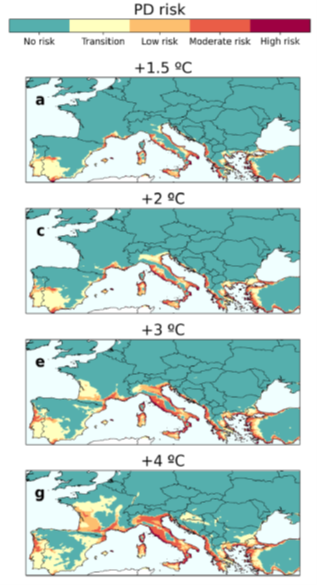 |
Figure 4: The risk of Pierce’s disease in Europe under different climate thresholds. Source: 7 Gimenez-Romero, A. et al. 2024. Global warming significantly increases the risk of Pierce's disease epidemics in European vineyards. Scientific Reports, 14(1): 9648, Figure 3. (Creative Commons Attribution 4.0 International License, http://creativecommons.org/licenses/by/4.0/) |
Epidemiological modelling (Figure 4) has shown that there will be a signficant risk of Pierce’s disease in European vineyards if and when temperatures reach above +2°C warming level and above +3°C the disease could spread beyond the Mediterranean region (7 Gimenez-Romero et al. 2024). Conversely, models have predicted that the severity of Pierce’s disease will remain low in China, despite increasing temperatures (8 Godefroid et al. 2022).
What can national plant protection organisations do to reduce future impacts
Incorporate the impact of recent and future climate change into Pest Risk Analyses
Consider whether current regulation of the trade in plants for planting provides adequate protection against Xylella
Keep surveillance plans under review in the knowledge that the distribution and biology of pests is changing as a response to climate change and that Xylella may be present yet asymptomatic.
References
1Almeida, R. P. P. and Nunney, L. (2015). How do plant diseases caused by Xylella fastidiosa emerge? Plant Dis 99(11): 1457-1467.
2Calderoni, F., Petrontino, A., Frem, M., Fucilli, V. and Bozzo, F. (2025). Economic and social impacts of olive quick decline syndrome: analysing data from the Italian farm accountancy network. Plant Pathology 74(4): 1010-1023.
3EFSA, Cavalieri, V., Fasanelli, E., Furnari, G., Gibin, D., Gutierrez Linares, A., La Notte, P., Pasinato, L., Stancanelli, G. and Delbianco, A. (2025). Update of the Xylella spp. host plant database - Systematic literature search up to 30 June 2024. EFSA J 23(2): e9241.
4Farigoule, P., Chartois, M., Mesmin, X., Lambert, M., Rossi, J. P., Rasplus, J. Y. and Cruaud, A. (2022). Vectors as sentinels: Rising Temperatures increase the risk of Xylella fastidiosa outbreaks. Biology 11(9): 1299.
5Feil, H. and Purcell, A. H. (2001). Temperature-dependent growth and survival of Xylella fastidiosa in vitro and in potted grapevines. Plant Disease 85(12): 1230-1234.
6Fuller, K. B., Alston, J. M. and Tumber, K. P. (2014). Pierce's disease costs California $104 million per year. California Agriculture 68(1): 20-29.
7Gimenez-Romero, A., Iturbide, M., Moralejo, E., Gutierrez, J. M. and Matias, M. A. (2024). Global warming significantly increases the risk of Pierce's disease epidemics in European vineyards. Sci Rep 14(1): 9648.
8Godefroid, M., Cruaud, A., Streito, J.-C., Rasplus, J.-Y. and Rossi, J.-P. (2022). Forecasting future range shifts of Xylella fastidiosa under climate change. Plant Pathology 71(9): 1839-1848.
9Greco, D., Aprile, A., De Bellis, L. and Luvisi, A. (2021). Diseases caused by Xylella fastidiosa in Prunus Genus: An overview of the research on an increasingly widespread pathogen. Front Plant Sci 12: 712452.
10IPPC Secretariat. (2017). Facing the threat of Xylella fastidiosa together. From https://www.ippc.int/static/media/uploads/IPPC_factsheet_Xylella_final.pdf.
11Leith, J., Meyer, M., Yeo, K.-H. and Kirkpatrick, B. (2011). Modeling cold curing of Pierce’s disease in Vitis vinifera ‘Pinot Noir’ and ‘Cabernet Sauvignon’ grapevines in California. Phytopathology: 1492-1500.
12Marco-Noales, E., Barbe, S., Monterde, A., Navarro-Herrero, I., Ferrer, A., Dalmau, V., Aure, C. M., Domingo-Calap, M. L., Landa, B. B. and Rosello, M. (2021). Evidence that Xylella fastidiosa is the causal agent of almond leaf scorch disease in alicante, mainland Spain (Iberian peninsula). Plant Dis 105(11): 3349-3352.
13Purcell, A. H. (2023). Xylella fastidiosa diseases in Europe: New encounters. Agrarian sciences Retrieved 25 April, 2025, From https://www.agrariansciences.it/2023/02/xylella-fastidiosa-diseases-in-europe.html.
14Rossi, J. P. and Rasplus, J. Y. (2023). Climate change and the potential distribution of the glassy-winged sharpshooter (Homalodisca vitripennis), an insect vector of Xylella fastidiosa. Sci Total Environ 860: 160375.
15Saifi, R., Kokiçi, H., Saifi, H., Akça, ?., Benabdelkader, M., Xhemali, B., Çota, E. and Hadjeb, A. (2024). Does climate change heighten the risk of Xylella fastidiosa infection? Plant quarantine challenges under climate change anxiety. K. Abd-Elsalam and S. Abdel-Momen, Springer nature: 331-358.
16Thorne, E. T., Stevenson, J. F., Rost, T. L., Labavitch, J. M. and Matthews, M. A. (2006). Pierce’s disease symptoms: Comparison with symptoms of water deficit and the impact of water deficits. American Journal of Enology and Viticulture 57(1): 1-11.
17Vicent, A. (2023). The Xf outbreak in Alicante, a talk with Antonio Vicent. From https://bexylproject.org/updates/news/the-xf-outbreak-in-alicante-a-talk-with-antonio-vicent/.