

The impact of climate change on kudzu (Pueraria montana var. lobata)
The impact of climate change on kudzu (Pueraria montana var. lobata)
Introduction to the pest
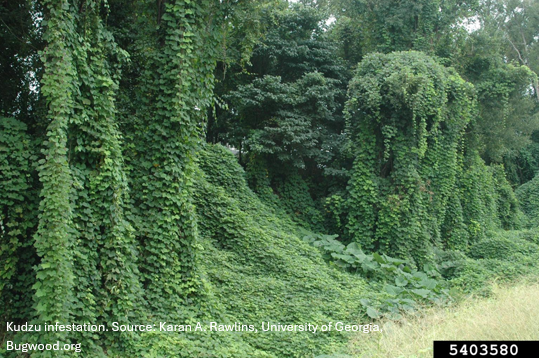
Kudzu (Pueraria montana var. lobata) is a perennial semi-woody climbing vine in the legume family (Fabaceae). It is known for its rapid growth and ability to overgrow and smother existing vegetation in a thick tangle of leaves and vines. The vines develop from crowns and are supported by a large tuberous root system. Dense populations reduce biodiversity and transform ecosystems by competing for resources, replacing native and desirable plants, and changing nutrient, water and fire cycles. Significant impacts are incurred by the forestry sector through productivity losses and increased costs of weed control. Buildings, infrastructure, parks, orchards and crops are also impacted. As a carrier of soybean rust (Phakopsora pachyrhizi), kudzu contributes to this serious fungal disease that causes yield losses in soybean. Kudzu can also impact air quality, as it is a major producer of isoprene and nitrous oxides, which lead to ozone formation. Kudzu is listed among the top 100 of the world’s worst invasive species (9 ISSG, 2015; Kato-Noguchi, 2023).
Origin and distribution
Kudzu is native to East and Southeast Asia and has been introduced on all continents except Antarctica (Figure 1). Pueraria montana var. lobata is the most widespread and invasive of three varieties (including var. montana and var. thomsonii) that some taxonomists prefer to recognize as three distinct species. Much of the information on its invasiveness is from the southeastern United States of America, where there are severe infestations. Kudzu is also invasive in countries such as Croatia, Bosnia and Herzegovina, and South Africa (3 CABI, 2025). Intentional planting for various purposes (ornamental, forage, erosion control, culinary, medicinal) is the most significant pathway of introduction. It may also be introduced through movement of contaminated soil, garden waste or equipment. Once established, it can spread by stems rooting at nodes in contact with the soil and forming independent plants. In some areas, spread by seed also occurs. Kudzu grows in a variety of habitats, including abandoned fields, field edges, pastures, grasslands, broad-leaved or mixed forests, tree plantations, roadsides, riverbanks and urban areas. It thrives on many soil types, even those that are nutrient poor, due to its ability to fix nitrogen.
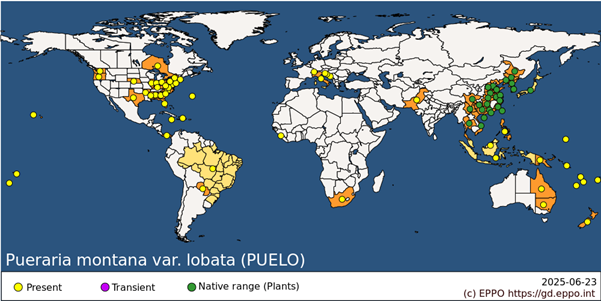
Figure 1: Current distribution of Pueraria montana var. lobata. Presence is shown with a yellow dot on the centre of each country (or, where available, each province/state for large countries) together with an orange background. For large countries where information is only available at country level, the whole country is shaded in pale yellow instead of orange. Source: EPPO (European and Mediterranean Plant Protection Organization). 2025. EPPO global database: Pueraria montana var. lobata (PUELO). [Accessed on 23 June 2025]. https://gd.eppo.int/taxon/PUELO/distribution
How the distribution and impact of the pest are affected by weather and climate
Kudzu is a C3 plant that tolerates a broad range of climatic conditions but prefers areas with mild winters (5 to 15 ºC), hot summers (over 25 ºC) and at least 100 cm of precipitation annually (13 Mitich, 2000). Growth rates increase as temperatures increase, reaching a maximum at 35 ºC (12 Lindgren et al., 2013). Above 35 ºC, kudzu regulates leaf temperature by adjusting the leaf angle, which may help it maximize photosynthesis while minimizing damage. Kudzu’s deep tuberous roots and efficient hydraulic architecture protect against fluctuations in water availability (Lindgren et al., 2013). When experiencing temperature or water stress, the plants’ isoprene emissions increase sharply, which can lead to increased ozone production and negative impacts on air quality (7 Forseth and Innis, 2004). Although the limit of kudzu’s distribution was previously thought to correspond with the ?20 ºC minimum winter temperature isocline, recent studies suggest that it can survive beyond this threshold due to cold acclimation (5 Coiner et al., 2018).
Based on current climate conditions, models predict the potential distribution of kudzu to include many areas of the world. Beyond its native range, favourable areas include eastern coastal Australia; New Zealand; midwestern, western and southeastern United States of America; eastern Central America; northwest South America; southern Brazil; southern Europe, especially northern Italy and Slovenia; and parts of central Africa (5 Follak, 2011; 4 Callen and Miller, 2015; 8 Geerts et al., 2016). Although it is already present in many of these areas, it has not yet occupied all climatically suitable habitats.
How climate change may alter the distribution and impact of kudzu in the future
Warmer winter temperatures permit the expansion of kudzu into higher latitudes and elevations. In North America, the distribution of kudzu is already moving northward, and this northward spread is expected to continue. Globally, a generally poleward movement may be anticipated. Kudzu is also known to respond strongly to increasing carbon dioxide levels, which together with global warming and the plant’s ability to fix nitrogen could permit aggressive spread into novel habitats (12 Lindgren et al., 2013). As kudzu is adaptable to many precipitation regimes and is drought tolerant, locations that are expected to become wetter, drier or have a more variable precipitation are unlikely to have a significant effect on its potential for establishment.
Regional models show significant increases in the land area at risk of invasion due to climate change. In North America, range expansions in the Pacific Northwest and Northeast are projected (10 Jarnevich and Stohlgren, 2009; 2 Bradley et al., 2010; 1 Allen and Bradley, 2016). In Europe, where populations are still limited, but a doubling in distribution is expected, models anticipate a shift toward the north and east (14 Pérez et al., 2022). Models for other regions, such as Central and South America and Africa, are needed to better understand the species’ invasion potential around the globe.
What national plant protection organizations can do to reduce future impacts
Since intentional planting of kudzu is the most significant factor contributing to its spread, halting the import and sale of this species in areas at risk of invasion is essential to prevent further spread and impacts. This is especially important in areas where the species is still localized and has not spread to its full potential. Kudzu is already regulated by some countries as well as the European Union. In addition to regulation, other actions could include:
Eradicate small populations near expansion frontiers.
Increase awareness of this pest, its pathways and impacts.
Monitor community science platforms to identify potential new populations.
Review existing climate suitability models to account for new information on climate variability and species establishment, and to predict uninvaded areas that are most at risk.
Monitor high risk areas for new populations.
References
References
1 Allen, J.M. and Bradley, B.A. 2016. Out of the weeds? Reduced plant invasion risk with climate change in the continental United States. Biological Conservation, 203: 306–312.
2 Bradley, B.A., Wilcove, D.S. and Oppenheimer, M. 2010. Climate change increases risk of plant invasion in the Eastern United States. Biological Invasions, 12: 1855–1872.
3 CABI (Centre for Agriculture and Bioscience International). 2025. CABI Compendium: Pueraria montana var. lobata (kudzu). [Accessed on 23 June 2025]. https://www.cabidigitallibrary.org/journal/cabicompendium
4 Callen, S.T. and Miller, A.J. 2015. Signatures of niche conservatism and niche shift in the North American kudzu (Pueraria montana) invasion. Diversity and Distributions, 21(8): 853–863.
5 Coiner, H.A., Hayhoe, K., Ziska, L.H., Van Dorn, J. and Sage, R.F. 2018. Tolerance of subzero winter cold in kudzu (Pueraria montana var. lobata). Oecologia, 187: 839–849.
6 Follak, S. 2011. Potential distribution and environmental threat of Pueraria lobata. Central European Journal of Biology, 6(3): 457–469.
7 Forseth, I.N. and Innis, A.F. 2004. Kudzu (Pueraria montana): History, physiology, and ecology combine to make a major ecosystem threat. Critical Reviews in Plant Sciences, 23: 401–413.
8 Geerts, S., Mashele, B.V., Visser, V. and Wilson, J.R.U. 2016. Lack of human-assisted dispersal means Pueraria montana var. lobata (kudzu vine) could still be eradicated from South Africa. Biological Invasions, 18: 3119–3126.
9 ISSG (Invasive Species Specialist Group). 2015. The global invasive species database. Version 2015.1. [Accessed on 23 June 2025]. https://www.iucngisd.org/gisd/
10 Jarnevich, C.S. and Stohlgren, T.J. 2009. Near term climate projections for invasive species distributions. Biological Invasions, 11: 1373–1379.
11 Kato-Noguchi, H. 2023. The impact and invasive mechanisms of Pueraria montana var. lobata, one of the world’s worst alien species. Plants, 12(17): 3066.
12 Lindgren, C.J., Castro, K.L., Coiner, H.A., Nurse, R.E. and Darbyshire, S.J. 2013. The biology of invasive alien plants in Canada. 12. Pueraria montana var. lobata (Willd.) Sanjappa & Predeep. Canadian Journal of Plant Science, 93: 71–95.
13 Mitich, L.W. 2000. Kudzu [Pueraria lobata (Willd.) Ohwi]. Weed Technology, 14: 231–235.
14 Pérez, G., Vilà, M. and Gallardo, B. 2022. Potential impact of four invasive alien plants on the provision of ecosystem services in Europe under present and future climatic scenarios. Ecosystem Services, 56: 101459.