

From crisis to coordination: IPPC Standards Committee advances global plant health standards
Posted on Tue, 19 May 2026, 07:39
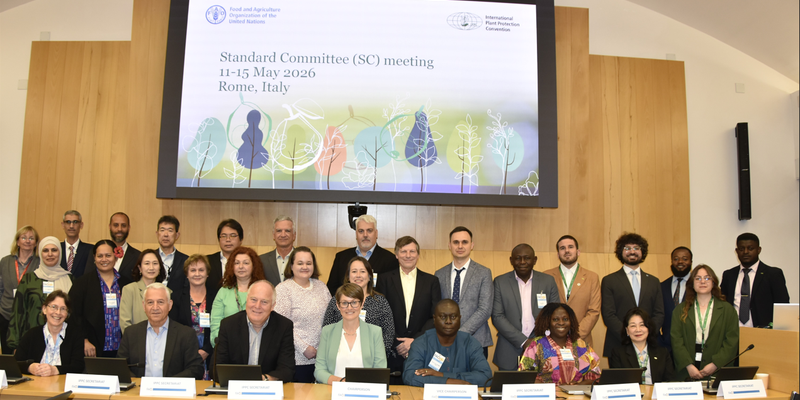
IPPC Standards Committee members and IPPC Secretariat staff ©FAO/ Anita Tibasaaga
Rome, 18 May 2026. “Without order, there is chaos. In a world increasingly shaped by global shifts and crises— from extreme weather events to other major disruptions—maintaining order is essential. I am therefore thankful that the Standards Committee is an order-setting committee”. This was the key message by Enrico Perotti, Secretary of the International Plant Protection Convention (IPPC), while opening the first of two annual IPPC Standards Committee (SC) meetings on 11 May in Rome. Perotti acknowledged the SC’s work on developing International Standards for Phytosanitary Measures (ISPMs) as fundamental to protecting agriculture, the environment and trade, and to bringing order to the global plant health system.
The SC, chaired by Sophie Peterson from Australia and comprising 25 international experts, oversees the IPPC Standard Setting process, manages the development of ISPMs and guides the work of technical panels and expert working groups, ensuring the scientific quality of proposed standards. The May meeting also welcomed new member Talal Abdullah Almutairi from Saudi Arabia.
New standards on the horizon
During the week-long meeting, the SC approved three draft annexes to ISPM 46 Commodity-specific standards for phytosanitary measures for the first round of consultation in July 2026, among IPPC contracting parties and regional plant protection organizations. This key step of the standard-setting procedure ensures an inclusive process that guarantees science and consensus-based norms. The approved draft annexes are:
-
International Movement of Citrus fruit (2023-019)
-
International Movement of seeds of Phaseolus vulgaris (common bean) (2023-008)
-
International Movement of Malus domestica (apple fruit) for consumption (2023-024)
The above are commodity-specific standards, also called next-generation IPPC standards, that aim to promote harmonized and technically justified phytosanitary measures for pests associated with specific commodities, to facilitate market access and ensure safe trade in plants and plant products. The next commodity standard to be developed is the international movement of Vitis vinifera fruit (2023-018).
Additionally, the draft specification on Revision of ISPM 3 (Guidelines for the export, shipment, import and release of biological control agents and other beneficial organisms) (2025-010) was approved for consultation from July to September 2026.
However, discussion on the draft ISPM—Requirements for the use of chemical treatments as a phytosanitary measure (2014-003) was deferred to the SC's next meeting in November 2026.
Governance and technical coordination
Other discussion points included outcomes of the Twentieth Session of the Commission on Phytosanitary Measures (CPM) held in March 2026 and the subsequent CPM Bureau meeting, presented by the IPPC Secretary. The SC welcomed CPM’s request to organize at least four expert working groups annually to support standards development. The Committee also acknowledged CPM’s endorsement of a Global Workshop on Commodity Standards, organized jointly by the IPPC Secretariat and the Asia and Pacific Plant Protection Commission (APPPC).
While reviewing the ongoing and planned work of its technical panels, the SC had a thorough discussion on the Technical Panel on Commodity Standards, particularly on the proposed criteria for excluding pests and measures from commodity standards, a key element of its work. The SC revised these criteria, which will soon be shared with the IPPC community. In preparation for the Global Workshop on Commodity Standards in 2027, the SC provided guidance on the draft workshop agenda and nominated three representatives to join the organizing committee.
Regarding the work of the Technical Panel on Phytosanitary Treatments, the SC confirmed the prioritization of five phytosanitary treatment submissions to be developed by the Panel:
- Priority 1: Cold treatment for Ceratitis capitata (fruit flies) on Actinidia deliciosa and Actinidia chinensis (kiwi fruit species)
- Priority 1: Hot water treatment protocols for Thaumatotibia leucotreta on Capsicum annum L.;
- Priority 1: Irradiation treatment for Drosophila suzukii (Spotted-wing fruit fly) on all host fruits and vegetables.
- Priority 2: Hot water treatment protocols for Bactrocera dorsalis (Oriental fruitfly) on Mangifera indica (mangoes)
- Priority 3: Ethanedinitrile fumigation for Hylurgus ligniperda and Hylastes ater in wood
Finally, the Committee acknowledged its improved collaboration with the IPPC's Implementation and Capacity Development Committee (IC) in strengthening the capacity of contracting parties to apply the standards.
Related information:
Advancing plant health and safe global trade through commodity-specific phytosanitary standards